proportion power calculation for binomial distribution (arcsine transformation)

              h = 0.344372
              n = 72.21261
      sig.level = 0.05
          power = 0.9
alternative = greaterSequential Testing for Experimental Design
Uses of Modern Sequential Testing

Platforms like Statsig implement the SPRT and it is quite easy to use.
AI Deployment Monitoring


- Monitor model quality after deployment
- Detect behaviors in real time without waiting for a fixed \(n\)
- Training: Reinforcement Leanring as a type of experiment
Early Stopping for Clinical Trials

- Stop early for efficacy or futility
- FDA-recommended group sequential designs
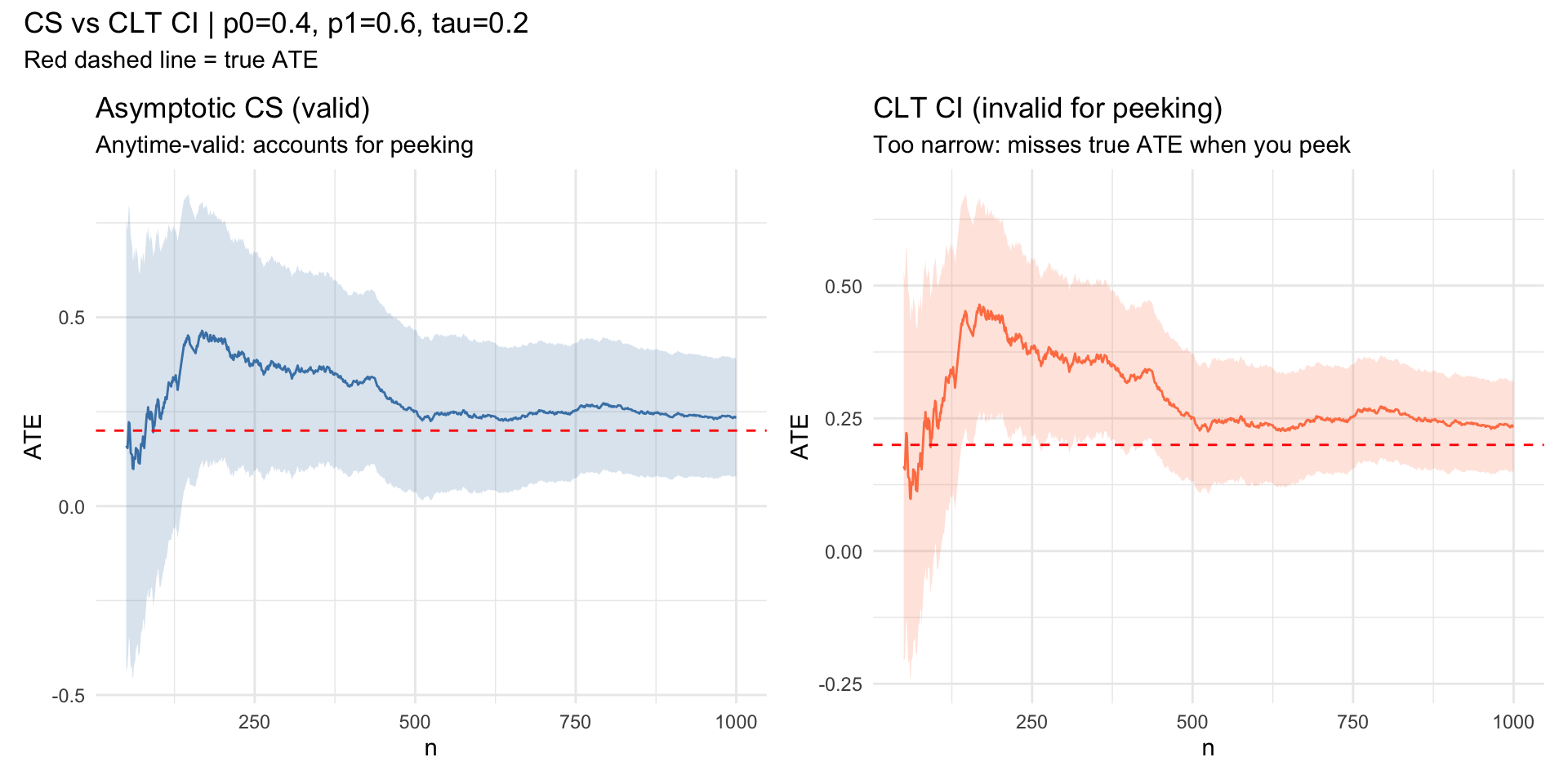
Confidence Sequences vs. CLT CI
Show simulation code
# --- Parameters ---
set.seed(7)
n <- 1e3; p0 <- 0.4; p1 <- 0.6; e <- 0.5
tau <- p1 - p0

Z   <- rbinom(n, 1, e)
Y   <- ifelse(Z == 1, rbinom(n, 1, p1), rbinom(n, 1, p0))
phi <- Z * Y / e - (1 - Z) * Y / (1 - e)

cs  <- robbins_confseq(phi)

ns     <- 1:n
mu_hat <- cumsum(phi) / ns
clt_hw <- qnorm(0.975) * running_sd(phi) / sqrt(ns)

df <- data.frame(
  t      = ns,
  ate    = mu_hat,
  cs_lo  = cs$lower, cs_hi = cs$upper,
  clt_lo = mu_hat - clt_hw,
  clt_hi = mu_hat + clt_hw
)[50:n, ]

p1_plot <- ggplot(df, aes(t)) +
  geom_ribbon(aes(ymin = cs_lo, ymax = cs_hi), alpha = 0.2, fill = "steelblue") +
  geom_line(aes(y = ate), color = "steelblue") +
  geom_hline(yintercept = tau, color = "red", linetype = "dashed") +
  labs(x = "n", y = "ATE", title = "Asymptotic CS (valid)",
       subtitle = "Anytime-valid: accounts for peeking") +
  theme_minimal()

p2_plot <- ggplot(df, aes(t)) +
  geom_ribbon(aes(ymin = clt_lo, ymax = clt_hi), alpha = 0.2, fill = "coral") +
  geom_line(aes(y = ate), color = "coral") +
  geom_hline(yintercept = tau, color = "red", linetype = "dashed") +
  labs(x = "n", y = "ATE", title = "CLT CI (invalid for peeking)",
       subtitle = "Too narrow: misses true ATE when you peek") +
  theme_minimal()

p1_plot + p2_plot +
  plot_annotation(
    title    = sprintf("CS vs CLT CI | p0=%.1f, p1=%.1f, tau=%.1f", p0, p1, tau),
    subtitle = "Red dashed line = true ATE"
  )
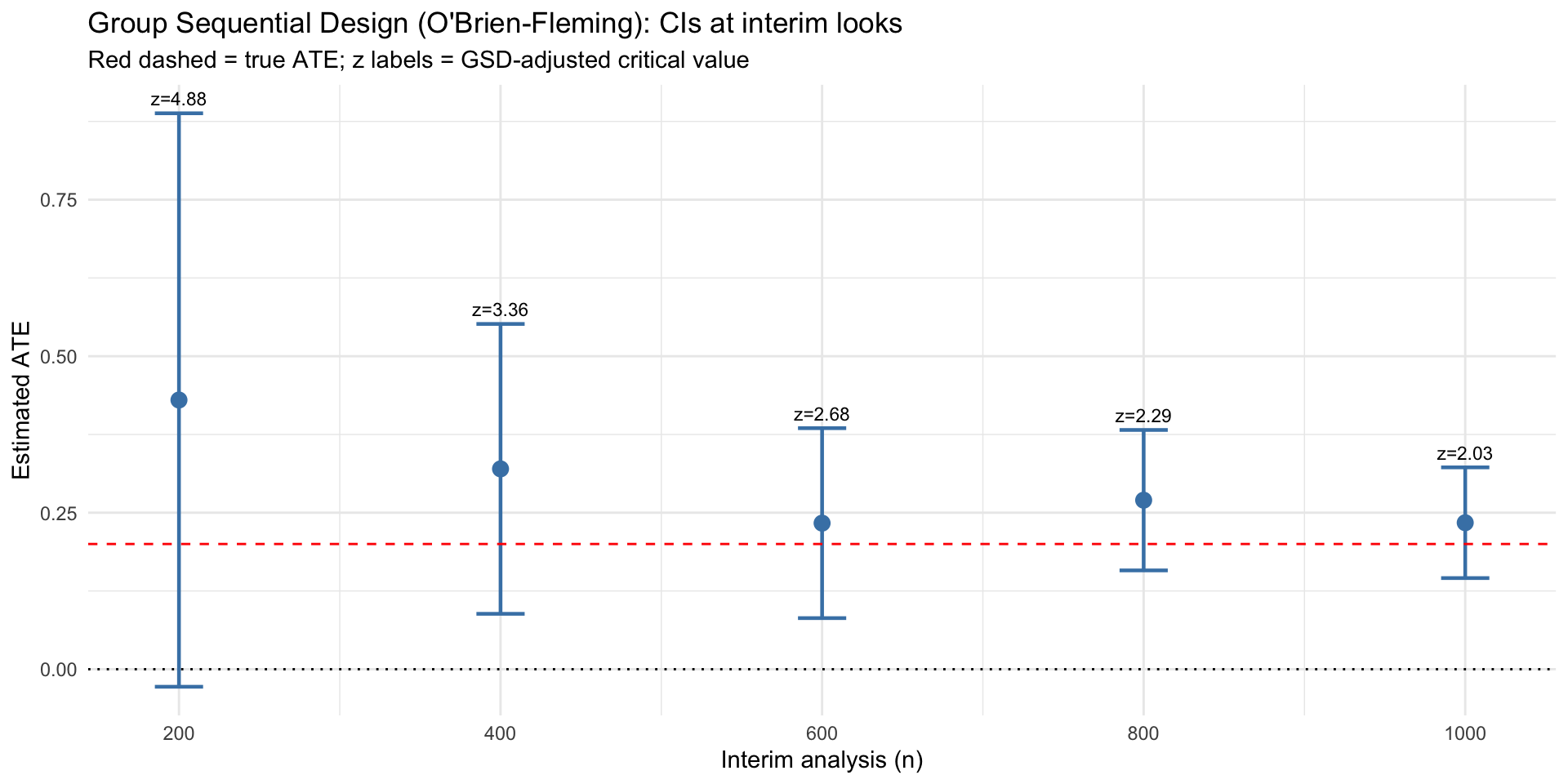
Group Sequential Designs in Action
Show simulation code
library(gsDesign)

# 5 equally-spaced interim analyses with O'Brien-Fleming spending
gs <- gsDesign(k = 5, test.type = 2, alpha = 0.025, beta = 0.1, sfu = sfLDOF)

interim_times <- c(200, 400, 600, 800, 1000)

gsd_df <- do.call(rbind, lapply(seq_along(interim_times), function(i) {
  t      <- interim_times[i]
  x      <- phi[1:t]
  mu     <- mean(x)
  se     <- sd(x) / sqrt(t)
  z_crit <- gs$upper$bound[i]   # GSD-adjusted critical value at this look
  data.frame(t = t, ate = mu,
             lo = mu - z_crit * se,
             hi = mu + z_crit * se,
             z_crit = round(z_crit, 2))
}))

ggplot(gsd_df, aes(x = t)) +
  geom_errorbar(aes(ymin = lo, ymax = hi), width = 30, color = "steelblue", linewidth = 0.8) +
  geom_point(aes(y = ate), color = "steelblue", size = 3) +
  geom_text(aes(y = hi, label = paste0("z=", z_crit)), vjust = -0.6, size = 3) +
  geom_hline(yintercept = tau, color = "red",   linetype = "dashed") +
  geom_hline(yintercept = 0,   color = "black", linetype = "dotted") +
  scale_x_continuous(breaks = interim_times) +
  labs(
    x        = "Interim analysis (n)",
    y        = "Estimated ATE",
    title    = "Group Sequential Design (O'Brien-Fleming): CIs at interim looks",
    subtitle = "Red dashed = true ATE; z labels = GSD-adjusted critical value"
  ) +
  theme_minimal()